How to Record Your Parent's Life Story: From Conversation to Book
Recording a parent's life story does not need to begin with a day-long interview or a promise to cover every year. This four-week plan uses a few short local or remote conversations and a review process that keeps your parent in control. The goal is not to collect the maximum number of memories, but to create a small set of stories your parent recognizes and approves for the agreed audience.
By Danila Pryadko · Updated
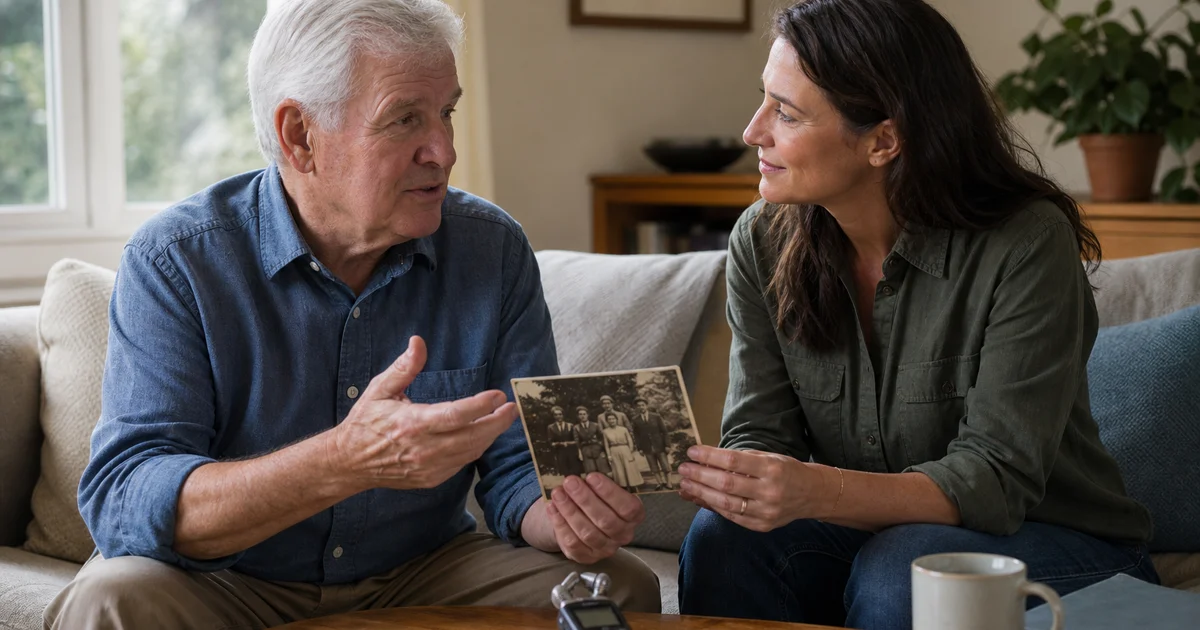
The complete path is:
shared purpose and consent → comfortable recording method → short conversations → named and backed-up files → faithful transcript → fact and privacy review → chapter drafts → narrator review → controlled reading copy
Publisher disclosure: MemoirWell develops family-story interview and memoir-drafting software, so this is first-party educational content rather than independent product coverage. The workflow below draws on the Oral History Association's best-practice and informed-consent guidance, the Smithsonian Institution Archives' oral-history guide, and the Library of Congress' personal digital-archiving guidance, all referenced on August 26, 2026. MemoirWell's editorial methodology explains the site's sourcing and disclosure standard.
If you have fifteen minutes: keep one story first
You can begin before organizing a larger project. Invite your parent to choose one ordinary subject: a route to school, a first task at work, or a room they knew well. Agree whether you will simply listen, take notes, or record, and who may see the result. A conversation can end as a private note.
- Choose the moment together. Ask “Which place or part of your life would you like to talk about today?” Let your parent redirect the topic.
- Follow one action. Ask “What would you do when you arrived?” Then leave space for the answer. Follow their words with one question at a time.
- Read back a short note. Keep their phrasing, mark a date as approximate, and ask whether anything should be changed or left out.
- Close the conversation. Agree where the note will be kept and whether they want to return to it. One useful story is enough.
Fifteen minutes is a possible stopping point, not a target your parent needs to meet. If they want to stop sooner, stop. If they do not want to begin, our guide to inviting a parent without pressure covers that decision.
A small note you can copy
Story chosen by:
Conversation date:
Working title:
Period described, including uncertainty:
Their words or a clearly labeled summary:
People and place:
Other sources or questions to check:
Changes requested when read back:
Who may read or hear this / where to keep it:
The conversation date and the date of the remembered event are different. Keep both. If you paraphrase an answer, call it a summary instead of placing it in quotation marks.
When several stories arrive out of order
Write a separate entry for each rather than interrupting to force a year-by-year account. Our free life-story timeline holds up to twenty moments with places, people and source notes. “Before the move” and unknown dates are allowed; move the entries yourself and keep any uncertain order labeled in the notes.
For example, “Walking to school,” “First wages,” and “The apartment above the shop” may emerge in that order during the conversation. Those are story choices, not proof of chronology. Ask your parent which they want to develop first, then use the longer plan below if a collection feels worthwhile.
The four-week plan at a glance
| Week | Main task | Concrete result |
|---|---|---|
| 1: Agree and prepare | Define the purpose, audience, boundaries, recording method, and first two topics. Test the setup. | A one-page project note, a consent record, working equipment, and a simple folder structure. |
| 2: Record | Hold two short conversations on different days. Let your parent pause, skip, or redirect. | Two intact recordings or sets of notes, plus brief session summaries. |
| 3: Organize and review evidence | Copy and name files, make backups, transcribe faithfully, and flag uncertain or sensitive details. | A source-preserving transcript, fact notes, privacy decisions, and a chapter outline. |
| 4: Draft and approve | Shape two to four short chapters, then review them with your parent in a comfortable format. | Corrected, narrator-approved chapter versions and a private reading copy. |
Four weeks is a frame, not a deadline. Your parent can take longer, stop after one chapter, or keep the result as private audio.
Before week one: choose a small, honest outcome
“Record your whole life” is too large for a first assignment. Start with three childhood stories, ten photographs, or a short private book about work, family, and retirement.
Write the purpose in one sentence:
We are recording a small collection of Mom's stories for a private PDF that she, her children, and her grandchildren may read.
That sentence is more than project management. It establishes a boundary. A private family PDF is not the same permission as a public website, podcast, archive deposit, social-media excerpt, or commercial book.
Week 1: agree on consent, boundaries, and format
The Oral History Association describes informed consent as an ongoing, transparent process. Your parent should understand what will happen from the first recording through the final copy, and should have a practical way to change a boundary during the project.
Separate the consent scopes
Avoid asking one vague question such as “Is it okay if I record this?” Discuss the separate uses:
| Scope | Question to settle |
|---|---|
| Participation | Does your parent want to take part in this project at all? |
| Recording | May you make audio, video, or written notes? Who else may be present? |
| Processing | Will anyone or any service transcribe, translate, summarize, or help draft the material? |
| Review | May your parent correct the transcript, restrict a passage, or remove material before the agreed cutoff? |
| Family access | Which named people may hear recordings, read drafts, or receive the finished copy? |
| Public use | Is any website, archive, podcast, social post, public event, or commercial edition permitted? If not, say so explicitly. |
| Future use | Would a later edition require a new review and permission? |
A brief written project note can record the date, participants, purpose, allowed audience, recording method, review plan, storage location, and current restrictions. At the start of each recording, you can also state the date and ask your parent to confirm the immediate scope in their own words.
Spoken permission does not replace a release or other document required by a publisher, archive, institution, contract, or applicable law. Recording-consent rules vary across U.S. states and other jurisdictions. If the recording will cross state or national borders, involve a person whose capacity to consent is uncertain, or be distributed publicly, check the requirements that apply to the actual participants and intended use.
Choose audio, video, or notes together
The best format is the one your parent knowingly chooses and can use comfortably. Audio preserves wording, tone, and pauses with less visual pressure. Video also preserves expressions, gestures, and objects, but can feel more formal and needs more storage. Notes or parent-written answers are valid when recording is unwanted, although they do not preserve exact voice; read important wording back for confirmation.
Do a two-minute test and play it back together. For an in-person session, use a familiar quiet place and check power and storage. For a remote session, agree on the recording method before the call, use the device your parent already knows, and keep a phone fallback. A clear phone conversation is more useful than a frustrating video call.
The list of questions to ask your parents about their life adds follow-ups and gentler options for sensitive topics.
Week 2: record two short, unhurried conversations
Plan two sessions on different days rather than one exhaustive interview. Twenty to thirty minutes can be enough for a first session. Stop sooner if your parent is tired, uncomfortable, or simply finished with the topic.
Session one: begin with a place and a routine
Concrete surroundings often provide an easier beginning than a request to summarize an entire decade. Try one opening question:
- What could you see from the front door of the home where you grew up?
- Walk me through an ordinary school morning.
- What happened in the kitchen on Sundays?
Listen for a detail you can invite your parent to expand: a person, object, smell, sound, task, or choice. Ask one follow-up at a time. “What happened next?” is usually more open than “Were you scared?”
Session two: explore one change and one reflection
Choose a transition your parent has already said they are willing to discuss: leaving home, starting work, moving, meeting a partner, becoming a parent, changing careers, immigrating, serving a community, or retiring.
If your parent served in the military, use the veteran oral-history guide for service records, terminology, interview boundaries, and the separate choice between a private family copy and an archival contribution.
Useful follow-ups distinguish what happened from what it later meant:
- What did you know at the time?
- What choice did you have to make?
- What detail would someone who was not there miss?
- Do you see that event differently now?
Do not use a prepared list as a quota. MemoirWell's separate questions to ask your parents about their life is a prompt library; this guide is about managing the complete project.
During every session
- State the date, participants, session number, and agreed purpose at the beginning.
- Remind your parent that they may pause, skip a question, or mark something off the record.
- Let silence remain long enough for thought, and note uncertain details instead of interrupting to correct them.
- At the end, ask what should remain private and who may hear this session.
- Save a brief session summary while the context is fresh.
If your parent says no to a topic, move on. If they withdraw from the project, stop recording. A smaller collection made with willing participation is better than a comprehensive book created through pressure.
Week 3: name, back up, transcribe, and review
The recording is now a source file, not disposable raw material. Preserve it before you begin cutting audio or rewriting prose.
Use names that remain understandable
The Smithsonian Institution Archives recommends identifiable file names and duplicate copies. Choose a system that avoids unnecessary private information while keeping the relationship clear:
PARENT01_2026-08-30_session-01_audio-original.m4a
PARENT01_2026-08-30_session-01_transcript-v1.txt
PARENT01_chapter-01_childhood-home_v2-parent-reviewed.docx
Keep version labels instead of repeatedly overwriting the same document. A simple project can use:
PARENT01/
  01_original_recordings/
  02_transcripts/
  03_source_and_privacy_notes/
  04_chapter_drafts/
  05_parent_review_and_reading_copy/
  README.md
In the readme, explain the project ID, purpose, naming pattern, audience, and restrictions. Do not put sensitive details or private addresses in a file name.
Make separate copies before editing
The Library of Congress recommends descriptive names, documented folders, and copies stored in different places. Keep the device original unchanged, make a working copy, and keep a separate recovery copy. Confirm that recordings play and documents open. Cloud storage can be one copy, but permissions still need to match the consent record.
For a deeper preservation workflow, see how to record your family history and how to organize family photos, letters and recordings.
Create a faithful transcript before writing a chapter
The first transcript should show what the recording contains. Use speaker labels, useful timestamps, and markers such as [inaudible 00:12:18] rather than guesses. Preserve “I think,” “maybe,” and other uncertainty. If a tool creates it, check names, dates, places, overlapping speech, and quotations against the recording. Keep these layers separate:
- Transcript: what was said.
- Source notes: what documents, photographs, or other relatives add or dispute.
- Chapter draft: the proposed reading version.
Never edit the preservation transcript to make it agree with a later correction. Add the correction as a dated note.
Review facts and privacy separately
Fact review asks, “What support do we have for this detail?” Privacy review asks, “Should this detail be included for this audience?” A detail can be accurate and still inappropriate for a particular edition.
Create a short decision table:
| Passage or claim | Fact status | Privacy decision | Draft treatment |
|---|---|---|---|
| Family moved in 1972 or 1973 | Uncertain; parent remembers both years | Safe for family edition | Write “in the early 1970s” or retain the uncertainty. |
| Employer name | Supported by a letter | Parent approves family-only use | Include only in the private edition. |
| Conflict involving a living relative | One person's recollection | Parent asks to exclude it | Omit; do not leave a disguised hint. |
| Childhood street address | Supported by an envelope | Exact address unnecessary | Use the town or street name only. |
Review names, dates, locations, quotations, historical claims, and chronology. Separately review details about living relatives, minors, health, finances, immigration, adoption, legal matters, conflict, and precise addresses. Difficult subjects do not have to disappear, but the narrator needs an informed choice about audience and wording, and other people's rights and privacy may also matter.
Week 4: turn the material into chapters and return it to the narrator
A transcript follows the order of a conversation. A readable chapter follows a meaningful thread. Group the material into two to four short chapters rather than forcing every answer into one continuous chronology.
A simple chapter can contain:
- a concrete scene or memory;
- enough context to understand the people, place, and period;
- the event or change at the center of the story;
- your parent's present-day reflection;
- photographs or captions that your parent has approved.
Edit repetitions for clarity, but do not manufacture dialogue, emotions, transitions, or certainty. Preserve distinctive phrases when they carry personality. Attribute documentary context instead of making it appear to come from memory.
For the full editorial method, use From Family Interview to an Author-Approved Chapter. That guide covers source notes, fact and privacy flags, neutral editing, version approval, and a preservation packet in greater depth.
Make narrator review easy to complete
Do not send a long manuscript with the instruction “Tell me what you think.” Offer a printed copy in comfortable type, an editable document with a short decision list, or a call where you read one section aloud. Show important quotations beside the transcript excerpt, and review sensitive passages separately.
Ask direct questions:
- Does this sound like you?
- Is the meaning accurate?
- Is anything too private for the agreed readers?
- May this exact version be included in the family-only book?
Record the reviewed version, date, reviewer, approved audience, unresolved questions, and method of approval. If a later edit changes meaning, a quotation, sensitive content, or audience, return that passage for review again.
Narrator approval is not a universal publication license. A private family approval does not automatically authorize a public website, archive, podcast, commercial edition, photograph, letter, or another person's private information.
Assemble the first book without losing the sources
Your first book can be modest: a title page, a note about who participated, two to four approved chapters, selected photographs, and a short source note. The reading copy should not include private consent records, contact details, or restriction notes merely for completeness.
Keep the reading copy and the controlled project packet separate. Before calling the edition complete, check that:
- every included chapter matches the parent-reviewed version;
- uncertainty has not been rewritten as fact;
- restricted material is absent from comments, tracked changes, file names, and document metadata;
- recordings, transcripts, notes, and approvals can be connected by file name or project ID;
- the recovery copy is separate, and actual access matches the audience in the project note.
You do not need to publish the book for it to matter. A private PDF or printed family copy can be the intended and complete result.
FAQ
How long should each conversation be?
Twenty to thirty minutes is a practical first session, but comfort matters more than the clock. Stop earlier when interest fades, and continue another day only if your parent wants to.
Can I record a regular phone or video call?
Only with the participants' knowledge and after checking the law and platform terms that apply. Consent and recording rules can depend on location and circumstance.
What if my parent is uncertain about dates?
Keep the uncertainty in the transcript and check documents separately. In the chapter, use an approximate period, attribute the recollection, present differing evidence, or omit an unimportant exact date.
Do all siblings need to agree with the story?
Different relatives can remember the same event differently. Do not let family voting replace narrator review. Record competing accounts separately and decide whether to attribute one perspective, include both, or leave the issue out.
Sources and review date
Sources were last reviewed on .