How to fact-check and correct an AI-generated memoir draft
Treat an AI memoir draft as a candidate, not a finished family record. Keep the recording and transcript unchanged, read the whole chapter once, compare each material name, date, place, relationship, quotation, and event with its source, then confirm, correct, qualify, remove, or flag unsupported details. Review privacy separately, read the revised prose again, and approve only the exact current version.
By Danila Pryadko · Updated
Publisher disclosure: MemoirWell develops the guided interview and memoir-drafting software shown here. This is first-party product instruction, not an independent review. Every name, answer, chapter, and correction in the walkthrough is synthetic. The method also draws on AI-risk, oral-history, and transcription guidance from NIST, the Oral History Association, the Smithsonian Institution Archives, the National Park Service, and the Library of Congress; none of those organizations endorses MemoirWell.
The short answer: use a seven-step review
- Preserve the original recording and a faithful transcript.
- Read the whole chapter once for meaning and voice.
- Compare every material claim with the source.
- Confirm, correct, qualify, remove, or flag each proposed detail.
- Read the changed prose again rather than trusting a checklist label.
- Review privacy and intended audience separately from accuracy.
- Approve only the exact current version you have re-read.
Do not begin with sentence polish. A fluent sentence can still contain an invented motive, a wrong year, a merged relationship, or a quotation the narrator never used.
Before opening the draft, preserve the source
Keep the original audio or video, a faithful transcript or detailed index, and source notes separate from the edited chapter. Do not rewrite the transcript to match polished prose. The National Park Service transcription guide describes a transcript as a lightly edited written record, recommends checking names and unclear passages, and sends the transcript back to the narrator for review. The Smithsonian oral-history guide likewise emphasizes preserving the interview in its original form rather than only an interviewer's interpretation.
A small source packet can use stable, versioned names:
01-interview-original.m4a
02-transcript-faithful-v1.txt
03-source-and-uncertainty-notes.md
04-chapter-candidate-v1.docx
05-chapter-reviewed-v2.docx
The recording answers what was said. The notes record what supports, challenges, or restricts it. The chapter is the reading copy. Keeping those layers separate makes later corrections traceable. For the wider workflow, see how to turn voice recordings into a memoir book and how to organize the family source archive.
This is source review, not proofreading
Proofreading can fix spelling and grammar while leaving a false claim untouched. Source review asks whether a material statement can be traced to the recording, transcript, narrator, family record, or another named source.
The NIST Generative AI Profile calls confidently presented erroneous or input-divergent content confabulation and notes that the risk is especially relevant to open-ended, long-form, highly contextual work. Memoir is both long-form and personal. The practical response is not to assume every polished sentence is false; it is to keep the source available and verify before approval.
Read once for voice and meaning
Before checking isolated facts, read the current chapter without editing. Ask whether it preserves what the narrator meant, sounds like that person rather than a generic inspirational essay, and avoids adding a moral, emotion, motive, or certainty that the interview did not supply.
Mark passages that feel wrong, but do not repair them from memory while reading. The first pass identifies where to look; the source comparison determines the responsible correction.
Build a claim checklist
| Claim type | What to check | Safer treatment when uncertain |
|---|---|---|
| Names | Spelling, preferred form, identity | Ask the narrator or use a role until confirmed |
| Dates and ages | Calendar, sequence, approximate period | Use around, in the early 1970s, or omit an unneeded exact date |
| Places | Town, street, employer, school, venue | Verify only the level of detail the story needs |
| Quotations | Recorded wording or reconstructed dialogue | Paraphrase or label remembered dialogue |
| Relationships | Who is related to whom and how | Check with the narrator and available records |
| Event order | What happened before and after | Retain competing sequences if evidence conflicts |
| Sensory detail | Weather, clothing, sounds, gestures, smells | Keep only what the narrator supplied or confirmed |
One sentence can contain several claims. Review them separately. MemoirWell's Facts to check list can focus attention, but it is not exhaustive fact extraction and it is not proof.
What the four fact actions mean
| Action | Use it when | What to verify next |
|---|---|---|
| Confirm | The proposed detail matches the source and belongs in this version | The surrounding sentence still represents the source fairly |
| Correct | The claim belongs, but its value is wrong or incomplete | The intended occurrence changed in the current prose and the old value is gone |
| Remove | The detail should not remain in the chapter | A revised candidate actually removes or rewrites the affected prose |
| Flag for rewrite | The whole passage needs another treatment, not a one-word replacement | The rewritten passage does not introduce a new unsupported detail |
A decision in the fact panel is not automatically the finished prose. After Remove or Flag for rewrite, inspect the revised candidate. After Correct, inspect the exact sentence. If the old value appears in more than one place or does not appear on one unambiguous text surface, use manual editing to choose the intended occurrence rather than accepting a blind replacement.
Preserve uncertainty instead of repairing it away
If the narrator says, “I think it was 1978,” do not silently turn that into “In 1978.” Keep the uncertainty, use an approximate period, attribute the recollection, or omit the date if the scene does not depend on it. Useful working labels include remembered directly, supported by a document, told by another relative, approximate, disputed, and unknown.
The full MemoirWell checklist may surface two date candidates with the same short question. Use the surrounding sentence and original source to decide what each item refers to; do not choose merely because one year already appears in the prose. The broader guide to writing with memory gaps covers honest uncertainty in more depth.
Review privacy separately from accuracy
A detail can be accurate and still be wrong for the intended readers. Review living relatives, minors, health, finances, legal matters, adoption, immigration, exact addresses, family conflict, and anything the narrator marked private.
- Is this claim supported or honestly qualified?
- Should this audience receive it?
Fact confirmation is not publication permission. Approval for a private family chapter does not automatically authorize a public website, podcast, archive deposit, social post, or commercial edition. MemoirWell's privacy notice and data-retention page explain the service's own handling; family permissions and third-party rights remain separate decisions.
Understand what Family-safe preview does
In the current interface, Family-safe preview is not a passive read-only preview. Selecting it starts a revision request: the page changes to “I am revising this chapter now,” disables the fact controls while processing, and later returns to the saved chapter state. Finish the fact decisions you intend to apply before starting it, wait once for the result, and then read the resulting prose. Do not click it repeatedly because the label sounds like an ordinary display control.
This is also an interface clarity issue: an action that initiates generation should be labeled and explained more explicitly. Until that wording changes, this guide states the actual behavior.
Approve one exact version
Before approval, confirm that the current chapter matches the source and accepted corrections, uncertainty remains visible, restricted details are absent for the intended readers, and the narrator has read or heard this exact version. Approval remains unavailable while required facts or the family-safe review are incomplete.
Earlier drafts are useful evidence, but a restorable version is not automatically an approved version. If you restore or edit a prior draft, repeat the fact and privacy review on the new current version.
Final AI memoir editing checklist
- Original recording preserved
- Faithful transcript or index preserved
- Names and relationships checked
- Dates, places, quotations, and event order checked
- Unsupported details qualified, removed, or rewritten
- Privacy reviewed for the intended audience
- Corrected prose, not only a fact label, verified
- Current version read again after every saved edit
- Exact version approved only after all review steps
If you want to try the same path, start one private chapter in MemoirWell, keep the original answer beside you, and stop at review until every material detail feels true.
Review and correct a chapter in the current MemoirWell interface
These screenshots were captured from the live English-language MemoirWell path with a disposable synthetic story. They show the actual controls and wording; no customer story, email address, payment detail, or private family material appears.
Open the chapter from Read & approve
When a draft is waiting, MemoirWell pauses the next interview and shows Review chapter 1. Open the draft instead of treating its presence as completion.
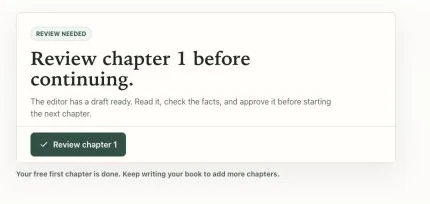
The live review-needed state for a synthetic first chapter; the next interview remains paused.Current product path: https://app.memoirwell.com/?locale=en#session Read the current chapter before using the checklist
Read for meaning, voice, and unsupported additions first. The synthetic current version shown here includes a prior correction to the year and bowl color; the review steps remain incomplete until the remaining claims are decided.
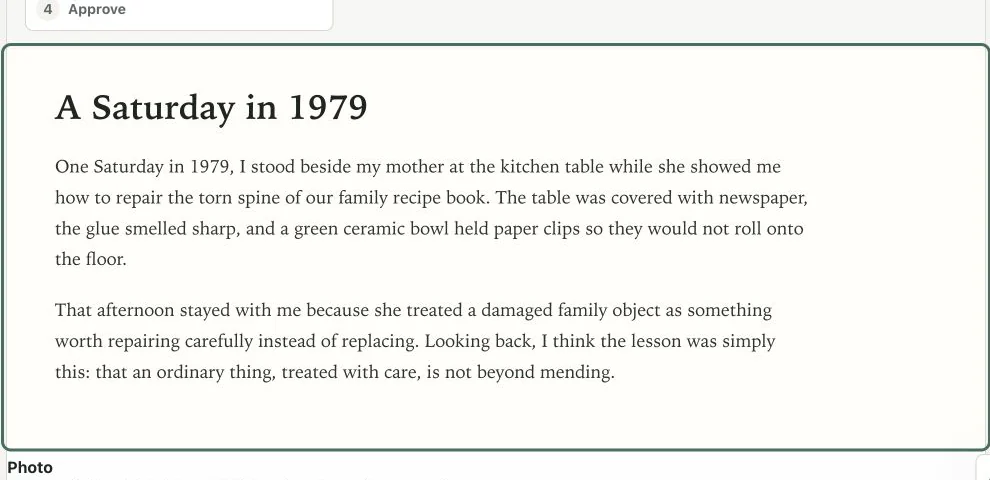
Read the whole synthetic current version, not only the facts that MemoirWell proposed for review.Current product path: https://app.memoirwell.com/?locale=en#chapter Decide one proposed fact at a time
Facts to check presents one claim with Confirm, Correct, Remove, and Flag for rewrite. The counter is a work queue, not proof that software found every factual statement in the prose.
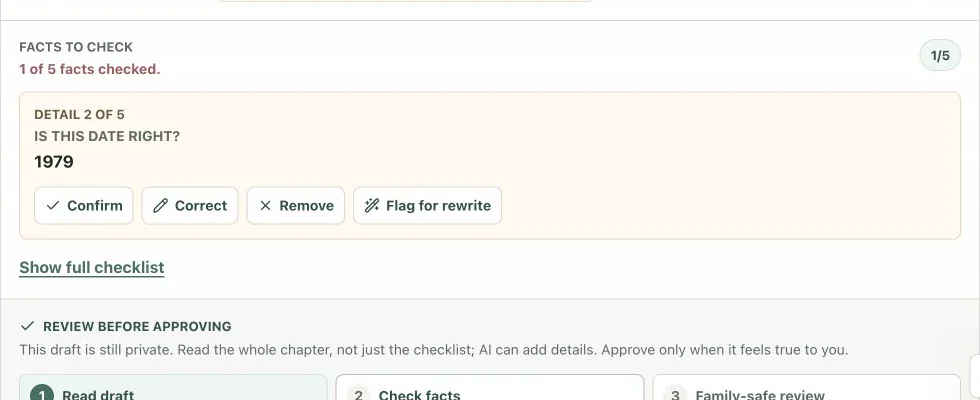
The live fact-review queue on a synthetic chapter; one of five proposed facts has been checked.Current product path: https://app.memoirwell.com/?locale=en#chapter Use Correct only after checking the source
Correct opens the proposed value and its detail type. Enter the supported replacement, then verify the resulting chapter itself; opening this form does not change the story until the correction is submitted.
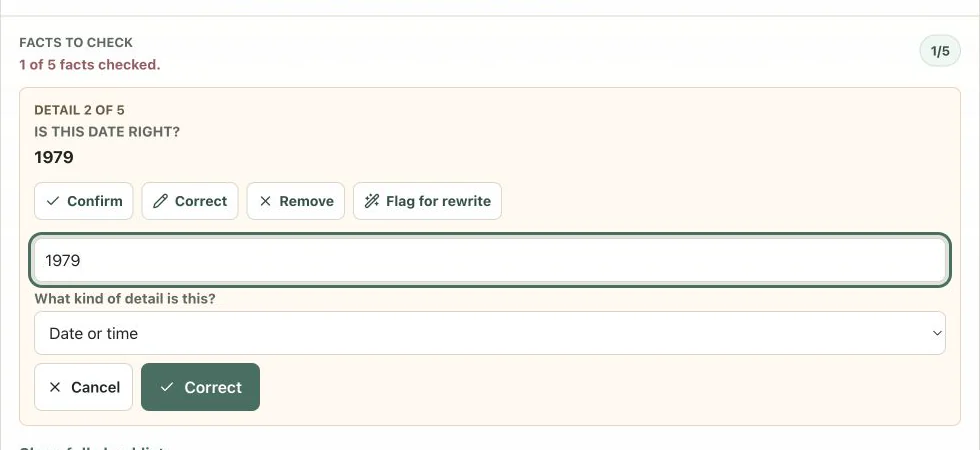
The live Correct form opened on synthetic data; this capture was canceled without saving another change.Current product path: https://app.memoirwell.com/?locale=en#chapter Verify the current version and keep earlier drafts identifiable
After a saved edit, re-read the current prose and confirm that the old value is gone from the intended passage. Earlier drafts remain separately labeled, while approval stays blocked until the fact and family-safe reviews are complete for the current version.
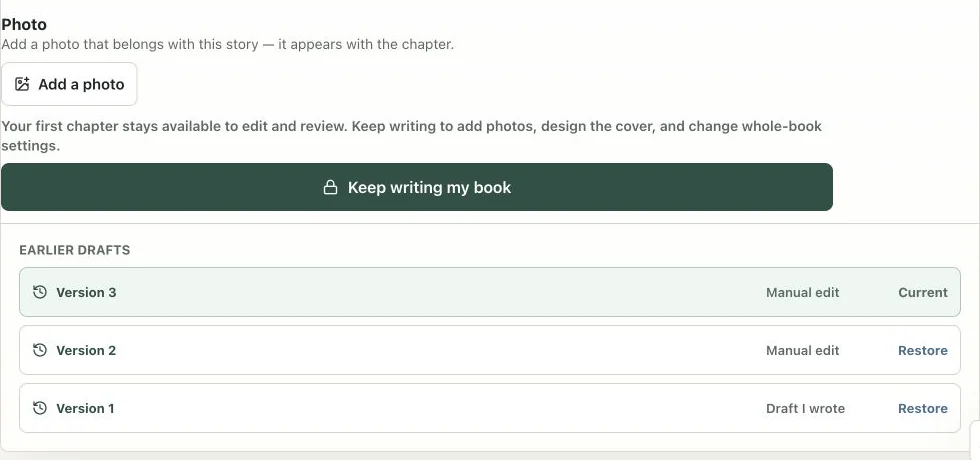
The synthetic chapter keeps the manual-edit version current while earlier drafts remain identifiable.Current product path: https://app.memoirwell.com/?locale=en#chapter
FAQ
Can an AI-generated memoir be fact-checked automatically?
Software can highlight names, dates, places, and other claims, but it cannot know whether a personal memory is true, incomplete, private, or disputed. The narrator and available sources must decide how each claim is treated.
What if the narrator and a document disagree?
Preserve both. The memoir can attribute the narrator's recollection while source notes record the documentary evidence. Do not silently rewrite one into the other or force certainty.
Should remembered dialogue use quotation marks?
Use quotation marks only when the wording is supported or clearly presented as remembered dialogue. Otherwise paraphrase and avoid implying a verbatim record.
Does correcting one fact approve the chapter?
No. Re-read the changed prose, complete the remaining fact and family-safe review, and approve only the exact current version.
What should I do with an uncertain date?
Keep an honest range or qualifier, attribute the recollection, seek another source, or omit the date if the story does not require false precision.
Sources and review date
This guide and its sources were reviewed on .