School days and teenage memories: start with an ordinary day
You may remember the route to school more clearly than a graduation. A pocket full of bus fare, a place you waited or the first task at a weekend job can give you a scene to write. Begin with what you can describe, even when the year, names or order of events remain uncertain.
By MemoirWell · Updated
Choose a place you used, not a whole decade
“My teenage years” asks for too much at once. “The stop where I waited for the late bus” gives you a smaller subject. Choose one place and roughly which part of your life it belongs to. You can use “before we moved,” “when I worked Saturdays” or “during my last year at that school.”
School does not have to be the center of the story. If you left early, studied at home, worked, cared for someone or moved between schools, choose a place from that life. A workshop, kitchen, library or relative's home is just as useful. You decide which period and subject you want to revisit.
Prompts for school days and the years around them
Pick one row, then one question. These prompts are invitations to write; you do not have to complete them or supply a happy ending.
| A starting point | A question to follow | A detail to look for |
|---|---|---|
| The journey | Where did you wait, turn or stop on the way? | Something you carried, counted or watched. |
| A classroom or learning place | What did you do when you arrived? | Where you put your things or who spoke first. |
| Break time | Where could you go when you had a few minutes to yourself? | A small action rather than a list of friends. |
| A friendship | What did you actually do together on an ordinary afternoon? | A shared task, route, game or habit. |
| Work or responsibility | Which task did someone first trust you to do? | How you learned it and what you checked. |
| Clothes or an object | What did you wear, carry, repair or save? | What you did with it, beyond how it looked. |
| Music and spare time | Where were you when you listened, practiced or read? | Who chose what happened next. |
| A change | What was different on the first day after a move or new responsibility? | One action that became easier or harder. |
If an object is the clearest starting point, the keepsake-story template helps connect it to a scene. For the home you returned to, try the childhood-home prompts.
Make a three-moment timeline before writing
On paper, or in our free life-story timeline, make three short entries: a familiar routine, a change, and something that came later. They need not cover consecutive years. The purpose is to place a few scenes beside each other, not to produce a complete biography.
- Name each moment. “Waiting at the bakery,” “The new bus route,” and “Walking home with Jo” are useful working titles.
- Add the period you actually know. A broad range, an age or “after the move” is enough. Leave the date empty when you cannot place it.
- Keep one action and one source note. For example: “I remember holding the fare in my hand. My sister thinks this happened a year later.”
- Choose an order provisionally. Put an uncertain entry where it is useful for writing and say that its position is uncertain. The worksheet will not infer a date.
Read the entries together. Which one gives you something to describe next? Choose that scene. The other notes can wait. You can print or download the timeline without signing up.
A remembered routine is different from one particular day
Some memories arrive as repeated actions: waiting in the same place, helping with dinner, working through an assignment. Write “On school mornings, I usually…” when you are describing a routine. Do not turn several mornings into one precisely dated event just to make the paragraph neater.
If a single day stands out, follow its order: what you were doing, what changed, and where the moment ends. Exact dialogue is optional. “She told me which bus to take” can preserve the action without inventing words inside quotation marks.
From a rough note to a scene: an invented example
The following example is fictional. It demonstrates a writing choice, not a customer's experience or a recovered memory.
Starting note: “Early teenage years, after the move? Waited by bakery for bus. Kept fare in hand. Brother usually there. Watched buses turn corner. Sister thinks different stop. Cannot place exact year.”
On school mornings, I remember waiting beside the bakery with the bus fare in my hand. My brother was usually there. I watched the corner where the buses appeared and tried to see which one was ours. I place this after the move, but I cannot settle the year. My sister remembers us using a different stop. I am keeping that question beside the story.
The paragraph keeps a routine as a routine. It adds no smell from the bakery, weather, conversation or reason for the move. Those might be vivid details, but the note does not support them. An unanswered question stays visible instead of becoming a confident date.
A separate reflection might say: “Looking back, I notice how carefully I watched for things I did not yet know.” That is the writer's view now. It does not claim that the teenager understood the moment the same way.
Use photographs and yearbooks without letting them supply a memory
A photograph can show a uniform, doorway or person in the frame. A yearbook can supply a printed name or date. Record what the source actually says separately from what you recall. A picture of a school concert does not establish that you attended it, liked it or remember what happened afterward.
| What you have | A clear way to keep it |
|---|---|
| A recollection | “I remember carrying my books in a canvas bag.” |
| A printed record | “The yearbook labels this class photograph 1983; page 24.” |
| Another person's account | “Jo says we walked home together; conversation on September 12.” |
| A mismatch | “I place this before the move; my sister places it afterward. Not resolved.” |
If you ask someone else, begin with “What do you remember about that journey?” before presenting your version. The Smithsonian's oral-history guide recommends open questions, one at a time, and distinguishing firsthand experience from stories heard elsewhere. Our photo questions offer a fuller way to keep an image and its accounts connected.
Decide what belongs in the version you share
Your working note and a story for relatives can be different versions. A classmate's full name, a private family disagreement or an exact address may be unnecessary for the scene. Keep only the detail the intended reader needs, and discuss any quoted contribution with the person who supplied it.
When interviewing a relative, agree on the purpose and audience and let them skip a subject or stop. The Oral History Association's best practices treat participation and narrator review as part of the process. Our exercises apply those principles to small family-writing projects; they are not a method for establishing the accuracy of a recollection.
Keep one scene, then choose the next step
Give the note a title and record when you wrote it, separately from the period it describes. Keep questions and source references with it. A short, clearly attributed scene is already a useful result.
For five questions focused on one scene, use the free memory worksheet. For several moments, use the life-story timeline. If you decide to develop one moment through MemoirWell's guided interview, the timeline lets you select that entry and explicitly add it to an empty interview answer after sign-in. Review any resulting draft against your notes before treating it as your story.
Keep the uncertain parts in your timeline
This real MemoirWell review screen uses synthetic example notes in a local product preview. It shows how an undated moment and an approximate date can sit together without either being rewritten.
Review your notes, then choose one scene
The date, remembered action and source note stay visible. Download the whole timeline or print it without an account. Developing a moment opens sign-in and offers only that selected entry for explicit insertion into an empty interview answer.
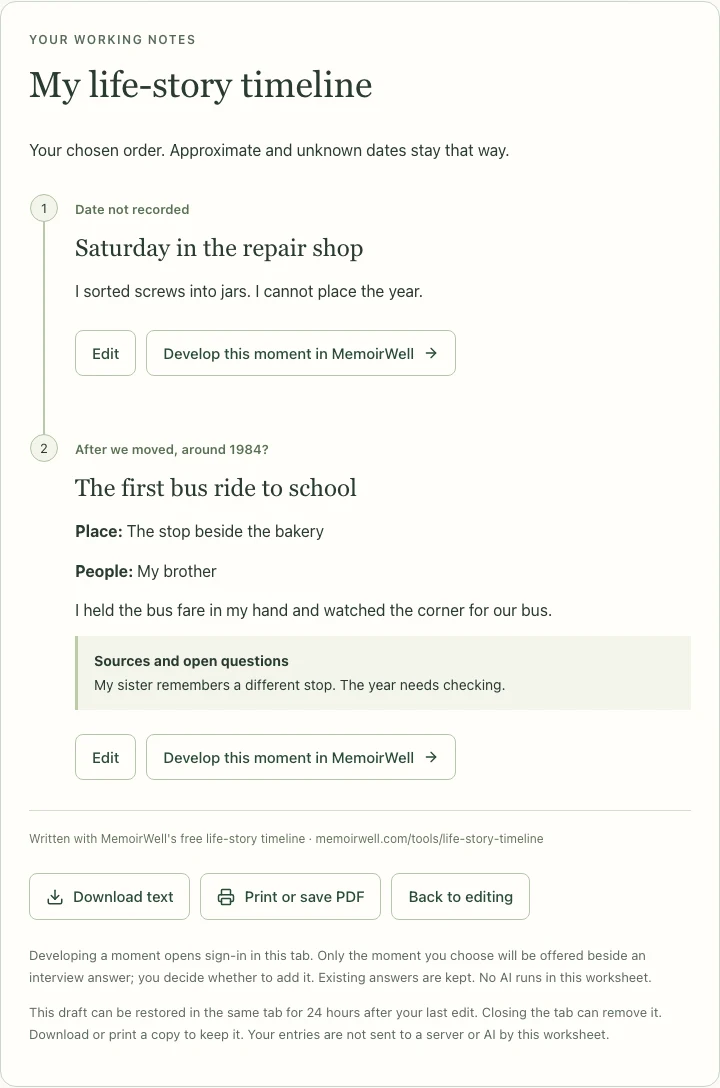
Actual MemoirWell timeline in a local product preview with synthetic notes. The unknown date and differing account stay visible; no AI draft was requested.Current product path: https://app.memoirwell.com/tools/life-story-timeline
FAQ
What can I write if I do not remember much about school?
Try a route, an object, a task or an ordinary routine from that period. You can keep a fragment and an open question. The prompts do not promise to recover forgotten events.
Do teenage memory prompts have to be about school?
No. Work, caring for someone, learning at home, friendships or a place you regularly visited can provide a starting point. Choose the part of your life you want to describe.
What if I cannot remember the year?
Use a broad period such as after the move, label an estimate, or leave the date blank. Keep any conflicting accounts with their sources. A precise year is unnecessary for a useful scene.
Can I use a yearbook or photograph to help?
Yes. Note what it shows or says, including the page or photo reference. Keep that evidence distinct from your recollection and from what another person tells you.
Sources and review date
Sources were last reviewed on .