How to write the story behind a keepsake
A toy, a recipe card or an old ticket may mean little to someone who finds it later. The missing part is often a simple story: who used it, what happened around it and why you kept it. You can write that story without knowing the object's age, value or complete history.
By MemoirWell · Updated
Choose an object with a scene attached
Start with something you can connect to an action: a cup someone used every morning, a toy you repaired, a ticket you saved or a recipe written in a familiar hand. A famous ancestor or a valuable heirloom is unnecessary. The useful question is “What happened around this?”
If several objects belong together, choose one for the first note. A box of letters may lead to dozens of stories; one envelope and the day you received it give this story an edge. You can make a short series later.
You can also write about something that has been lost, given away or worn out. Say that the object is no longer available and describe what you remember. A story does not require a surviving possession.
Five questions that move from object to story
- What is it? Describe its material, shape and distinctive marks. Begin with what you can see, or clearly identify a description made from memory.
- How did it enter your life? Who used it or gave it to you? Which parts of its earlier history do you know firsthand?
- Which moment do you associate with it? Follow one occasion when it was used, found, repaired, given or put away.
- Why does it matter to you now? The answer can be ordinary: it recalls a daily habit, a place or the way someone did things.
- What is still unknown? Leave room for an uncertain date, an unidentified maker or a family account you cannot check.
Answer these in a notebook or use the keepsake option in our free memory-writing worksheet. It assembles your answers without inventing a history, and you can download the text without signing up.
A copyable keepsake-story template
Keep this note with a reference photograph or in the same folder as its digital image. Give the photo and note the same recognizable name so they are easy to match. This template records a personal story; it is not an appraisal or proof of ownership.
Working title:
Object or item:
Visible details, or a description from memory:
People connected to it:
How it reached me:
One occasion I remember:
Why I am keeping this story:
What someone else told me, and who:
Uncertain details or questions:
Related photo or file name:
Written by / date written:
Do not let empty lines stop you. “Maker unknown” is an answer. “Aunt Lena told me this in 2019” is more useful than repeating her account as an established fact. If a relative reads the note and adds a correction, keep a dated copy of the earlier version so the change makes sense later.
An ordinary toy, two useful versions
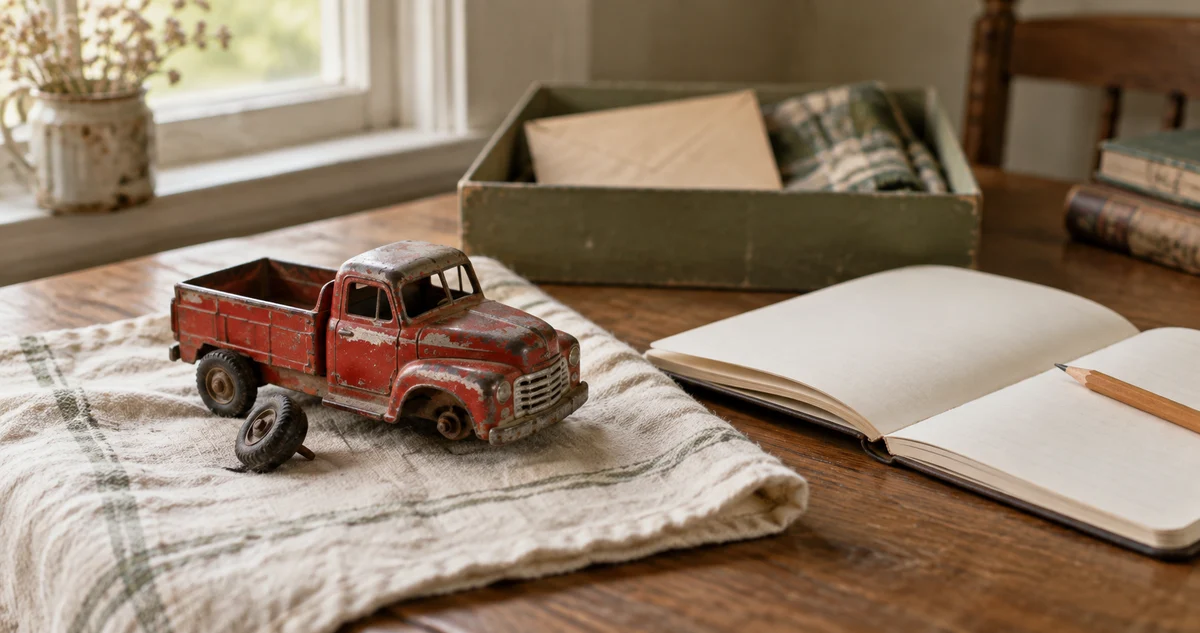
The following example is invented. The truck in the illustration is imagined too; it is not evidence for the story.
A short identification note: “Small red toy truck with chipped paint and one loose wheel. It was in my childhood toy box. I do not know who bought it or when.”
A longer memory:
I remember pushing this truck along the seam in the kitchen floor. The loose wheel would come off, and I would put it beside the truck until my father had time to look at it. I cannot remember whether he fixed it more than once. When I found the truck in a box years later, the separate wheel was still there. I kept both. To me, they belong to the same memory.
The short version helps someone identify the object. The longer version explains the relationship. Neither needs a brand, a year or dialogue that the writer cannot recall. The note can remain this length; it does not have to become a polished chapter.
Separate what the object shows from what the family says
| Information | Useful wording | What to avoid adding |
|---|---|---|
| A visible mark | “There are initials scratched underneath.” | An owner identified solely from matching initials. |
| Your own memory | “I remember using it at the kitchen table.” | An exact year you do not know. |
| A relative's account | “My uncle said it came from his father's workshop.” | Changing the account into a documented chain of ownership. |
| A guess | “I wonder whether this is the one in the photograph.” | Presenting resemblance as confirmation. |
FamilySearch's article on heirloom stories pairs an object's description with the people and memories connected to it. Our exercise uses that general idea, while keeping a separate space for uncertainty. If you interview a relative, the Smithsonian's guidance on open questions and firsthand versus secondhand accounts is a useful starting point.
Ask a relative without supplying the answer
Try “What do you remember about this?” and let the person choose where to begin. Follow with “When did you first see it?” or “Were you there, or did someone tell you that story?” Ask one thing at a time. “This was Grandma's wedding gift, wasn't it?” makes it harder to learn whether the person has a different account.
Write down who spoke and when. If you plan to share their words, agree on what they are comfortable including. You can keep a private note and prepare a shorter version for relatives. A meaningful story does not need every family detail in its public version.
When the object is ordinary or the story feels unfinished
Try writing a verb instead of a description: wore, carried, folded, repaired, lent, cooked, opened. Then finish “I remember someone…” A stained recipe card might lead to the order in which a person cooked. A school notebook might lead to where you sat while doing homework. An old key might lead to coming home.
If no scene follows, keep a simple identification note. That can still prevent a future reader from wondering whose item it was. You can add a memory later without rewriting the first note to sound more certain than it was.
Give the story a useful next home
Save a readable text copy beside the reference image. Keep the object's description and the date you wrote the note, even if you later turn the scene into a longer narrative. If the story belongs with several others, link the notes by person or place rather than putting all the background into the first paragraph.
A keepsake can become the opening of a memoir chapter: the object is the entry point, and the scene carries the story. You can develop it through MemoirWell's guided interview, then review the draft in your own voice. If a room rather than an object comes to mind, try the childhood-home prompts. For a box of mixed material, our guide to organizing family photos, letters and recordings covers the wider collection.
FAQ
What counts as a keepsake?
Any object with a personal connection can be a starting point: a toy, cup, tool, recipe card, letter or ticket. It does not need monetary value or a long family history.
How long should the story be?
A few identification sentences and one remembered scene can be enough. Keep the useful details and open questions. Expand only when you have more to say, rather than aiming at a word count.
Can I write about an object I no longer have?
Yes. Say that you are describing it from memory or from a photograph. Be clear about which details you can still check and which remain uncertain.
What if I do not know who originally owned it?
Write what you know about how it reached you, attribute any family accounts, and label the earlier history unknown. You can preserve a personal connection without establishing the object's full history.
Sources and review date
This guide and its sources were reviewed on .