Questions to ask parents and grandparents about old family photos
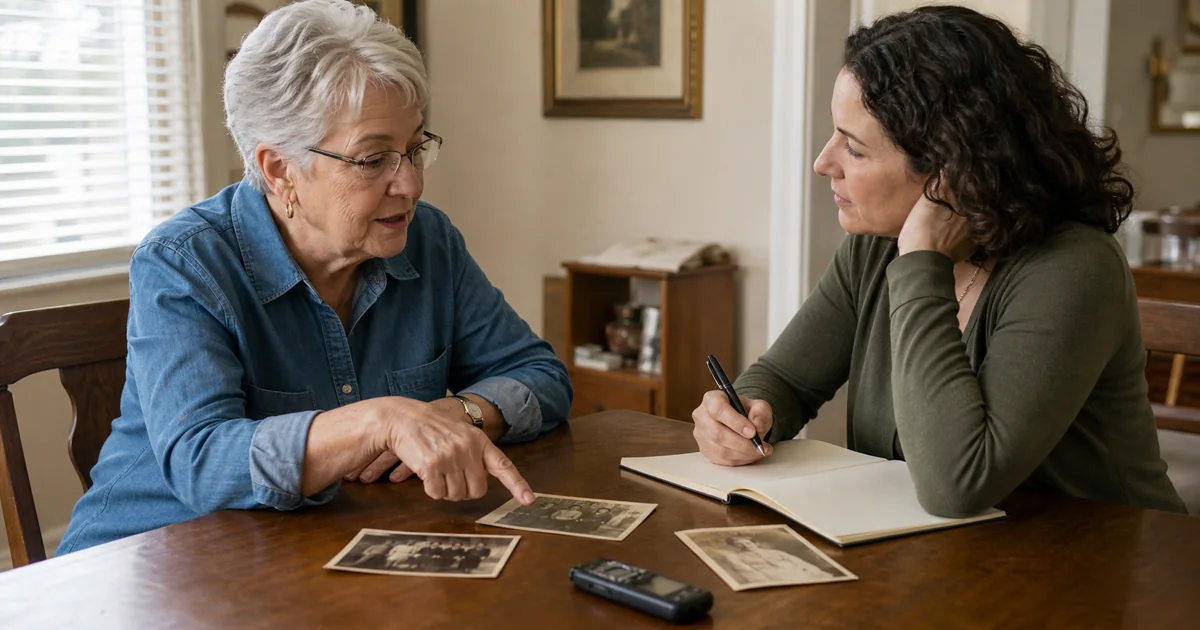
Choose three to five photographs, give each one a simple ID, and ask about more than the names in the frame. Ask where the picture was taken, what happened just before and after it, who is missing, why the photograph was kept, and what a stranger would misunderstand. If the narrator agrees to a recording, say the photo ID aloud, preserve the original answer, and label uncertain names or dates instead of guessing.
By Danila Pryadko · Updated
Publisher disclosure: MemoirWell develops guided family-story interview and memoir-drafting software. This is first-party educational content, not an independent product review or archival, copyright, or legal opinion. The example IDs and notes are synthetic. No customer, tester, or private family material appears in this guide.
Try this first: one photograph, five notes
If you have ten minutes and one photograph beside you, start here. You do not need to scan or upload it. Write five short notes: what is visible, what you know about the people and date, a remembered moment outside the frame, why the photo matters to you, and what remains uncertain.
Use the photograph option in our free memory-writing worksheet to work through those questions and download your own words. It does not identify faces, date images or generate missing details. The longer guide below explains how to bring a relative into the conversation and preserve the resulting account.
Three sentences, three different kinds of evidence
This miniature example is invented; it does not describe a customer or an actual photograph.
| Note | What it tells the reader |
|---|---|
| “Three people are sitting on a blanket beside a station sign.” | A visible detail, without an inferred relationship. |
| “My mother identifies the person on the left as her sister, Jo.” | An identification and the person who supplied it. |
| “I remember carrying the picnic bag, but I cannot place the year.” | A recollection with its uncertainty intact. |
A proposed caption could read: “Picnic beside the station, date unknown. My mother identifies Jo at left. I remember carrying the picnic bag.” Before sharing it, ask the people supplying the account whether the wording represents what they meant. A caption can remain short without hiding what is unknown.
Place three photo stories beside each other
Once you have a note for each image, a small timeline can reveal which question to ask next. The aim is to organize the accounts you have, not to fill the gaps between photographs. Keep each photo ID in its entry so the story can be traced back to the image.
This example is invented. The dates and people are fictional.
| Photo reference | Period as currently known | Story note | Source or open question |
|---|---|---|---|
| PHOTO-014: bakery doorway | Before the move, exact year unknown | Mother remembers waiting here for the school bus. | Her account; the photograph shows the doorway but no bus. |
| PHOTO-029: repair shop | Possibly 1978–1980 | Uncle Jo says this was his Saturday workplace. | Range supplied by Jo, not checked. Shop name partly obscured. |
| PHOTO-031: kitchen table | Order unresolved | Aunt Lena remembers the table in an earlier apartment. | Mother places it after the move. Keep both versions. |
Put these into the free life-story timeline with the photo ID and narrator in the sources field. You choose the order; the tool does not date photographs or settle conflicting accounts. Download the text to keep beside your photo notes.
A missing photograph does not require a missing story. Add a memory-only entry and say “No photograph located; narrated by…” so a future reader understands its basis. Likewise, an unexplained gap between two photographs can remain a gap. It is a useful question for another conversation, not an invitation to supply a likely event.
If the images lead to school routes, friendships or early jobs, the school-days and teenage-memory prompts help develop one of those scenes without trying to reconstruct an entire decade.
A photo interview is not a memory test
The goal is not to make a parent or grandparent prove that every name and date is correct. A photograph is a prompt for first-person context: what the room felt like, how people knew one another, what happened outside the frame, and why this moment mattered enough to keep.
The Library of Congress family-story guide recommends planning a topic, using short open questions, testing recording equipment, and noting who was interviewed, when, where, and about what. The Oral History Association's 2025 principles and best practices emphasize informed participation, open-ended guides, follow-up questions, accurate descriptive information, preservation, and narrator review.
Use those principles on a small scale. A useful first session can produce:
- a stable ID for each photograph;
- the narrator's own identification and story;
- a separate note for uncertain or conflicting details;
- a recording or written account linked back to the exact image;
- one scene the narrator can review before it becomes part of a memoir.
For the archive-wide workflow—inventory, provenance, filenames, master copies, permissions, and backups—use How to Organize Family Photos, Letters, and Recordings for a Memoir. This guide owns the narrower job of conducting the conversation.
For a complete session plan that is not organized around photographs, use How to Interview Your Grandparents. The broader questions for grandparents and questions for parents pages own general life-story prompt intent. This page is different: every question begins with a specific photograph and ends with that image linked to its recording, evidence, uncertainty, and review notes.
Before the interview: prepare five things
1. Choose a small, coherent set
Start with three to five photographs from one household, period, event, or family branch. Fifty unrelated images encourage quick labels; a small set leaves room for complete stories and useful follow-ups.
Include at least one photograph the narrator is likely to recognize easily. Do not begin with the most disputed, distressing, or private image merely because it seems dramatic.
2. Record the object before rearranging it
Photograph or scan the front and back, the album page, and any envelope or caption that came with it. Preserve the original order and wording, including question marks and misspellings. Do not discard the physical original after digitizing it; the National Archives family-archive guidance recommends retaining originals, adding basic descriptive information, and backing up digital copies.
If an original is fragile, stuck to an album, curled, torn, or valuable, do not experiment with cleaning or removal during the interview. Use a safe reference image and seek appropriate conservation guidance separately.
3. Give every photograph a stable ID
Use an ID that remains useful even if folders and captions change:
HART-PHOTO-001
HART-PHOTO-002
HART-PHOTO-003
Put the ID in the digital filename and interview notes. For physical materials, use an appropriate enclosure or a separate slip rather than writing across the image or attaching an ordinary adhesive label.
4. Explain the purpose and audience
Tell the narrator what you hope to create: private notes, a family-only recording, captions, a memoir chapter, or something else. Discuss recording, transcription, family sharing, quotation, online publication, and commercial publication as separate choices.
If you plan to record, ask first and explain how the file will be stored and reviewed. Recording, privacy, copyright, and release requirements vary by place, material, and intended use; this guide does not replace advice for a specific legal situation.
5. Test the recording and the view
Make sure both people can see the same numbered image. Test sound before the story begins. If meeting remotely, send only the selected images in advance and use the same IDs in both copies.
Begin the recording with a plain slate:
Interview with Eleanor Hartwell
August 27, 2026
Recorded at Eleanor's home with her permission
Photographs discussed: HART-PHOTO-001 through 005
Intended use: private family captions and a draft memoir scene
Avoid saying a precise home address in the recording when a general location is enough.
Questions about the people in the photograph
Begin with what the narrator sees, not with your preferred identification.
- Who do you recognize in this photograph?
- How did these people know one another?
- What names or nicknames did you use for them?
- About how old was each person here?
- Who took the photograph, if you know?
- Who might have another copy or remember this day?
- Is anyone important to the story outside the frame?
- What makes you confident—or uncertain—about an identification?
Avoid leading with “This is Uncle Robert, right?” A neutral question leaves room for another person, a nickname, a correction, or an honest “I don't know.”
When a living person is identified, treat that as information to review before public sharing, not automatic permission to publish their name or image.
Questions about place and time
- Where was this taken?
- What do you remember about that house, street, school, workplace, or landscape?
- What season or time of day does it seem to be?
- What clues help you place the photograph in a particular year or period?
- Had something in the family recently changed—a move, job, marriage, graduation, or arrival?
- What happened just before the picture was taken?
- What happened afterward?
Write “around 1968,” “probably at the Oak Street house,” or “Eleanor remembers this as the summer after the move” when that is what the evidence supports. Do not convert an approximate memory into an exact date merely to make a cleaner caption.
The Library of Congress guide to photographic evidence advises evaluating photographs and captions as evidence: consider date, place, context, original records, and competing clues rather than accepting one visual resemblance as proof.
A National Archives family-photo case study shows the right boundary for documentary context: census and marriage records helped identify people and relationships around a photograph, but one record did not establish the full family connection by itself. Use records to support, narrow, or challenge a conclusion, and keep the reasoning visible.
Questions about what is happening
- What were people doing when this picture was taken?
- Was the occasion ordinary, planned, or unexpected?
- What objects, clothing, tools, food, signs, or decorations matter to the story?
- What sounds, routines, or conversations do you associate with this scene?
- What job or responsibility did each person have that day?
- What would a stranger misunderstand by looking only at the photograph?
- Is the picture formal, or is someone performing for the camera?
These questions turn a label into a scene. “Helen, 1971” identifies a person. “Helen had just finished the early bakery shift and still wore flour on her sleeve” begins a story—but keep that detail only if the narrator supplies or later confirms it.
Questions about meaning and preservation
- Why do you think this photograph was kept?
- Who kept it, and how did it reach this album or box?
- Was there a story you heard whenever this picture came out?
- Does this photograph leave out a disagreement, hardship, or private fact that should not be assumed from the image?
- Which part of this story may be shared with family, and which part should remain private?
- What caption would you want a grandchild to read?
- What should remain uncertain rather than being presented as fact?
- Who should review the caption or story before it is shared?
Owning a physical print is not necessarily the same as owning copyright in the photograph. The U.S. Copyright Office explains that the photographer is generally the initial copyright owner, subject to exceptions and later transfers. Treat rights and permissions as item-specific questions, especially for public or commercial use.
Follow-ups that produce a story instead of a label
When an answer opens a scene, stay with it. Useful follow-ups include:
- What happened next?
- Who else was there?
- What did you notice first?
- What did this place look like when the camera was put away?
- What did you call that object or tradition in your family?
- How did you feel then, and how do you understand it now?
- Is that something you remember directly, or a story someone else told you?
- Is there another photograph, letter, or record that might clarify it?
- What wording would sound more like you?
- Is any part of this story not for the intended audience?
Ask one question at a time. Silence does not need to be filled immediately. If the narrator wants to skip an image, turn off the recorder, or stop the session, respect that choice.
Preserve uncertainty and disagreement
Two relatives may identify the same person differently. A handwritten caption may conflict with a memory. Clothing, a studio mark, or a census record may narrow a date without proving it.
Keep the accounts separate:
| Photo ID | Statement | Source | Status | Next step |
|---|---|---|---|---|
HART-PHOTO-003 |
“That is probably Aunt May.” | Eleanor interview, 2026-08-27 | remembered, uncertain | ask June without suggesting May's name |
HART-PHOTO-003 |
“Summer 1954” | writing on back | inherited caption | preserve exact writing; check event records |
HART-PHOTO-003 |
studio at this address from 1953–1956 | city directory notes | documented range | cite directory in research notes |
Possible labels are confirmed, probable, possible, disputed, and unknown. Write the evidence beside the label. A confidence word without its source is difficult for another relative to evaluate or correct.
This workflow does not require automated face matching, and identifiable family photographs should not be uploaded to a third-party biometric service by default. If you consider one, first determine whether you are authorized to upload the images and review the provider's current biometric processing, consent, retention, deletion, security, and jurisdiction terms. Any match is still only a candidate for human review; the conclusion needs provenance, dates, relationships, records, and transparent uncertainty.
Link the photograph to the recording
A recording becomes much harder to use when nobody knows which image is being discussed. Use the photo ID in every layer:
HART-PHOTO-003-front-master.tif
HART-PHOTO-003-back-master.tif
HART-PHOTO-003-access.jpg
2026-08-27-eleanor-photo-interview.wav
2026-08-27-eleanor-photo-interview-index.csv
Create a short index:
| Timecode | Photo ID | Topic | Review note |
|---|---|---|---|
00:00:00 |
— | recording slate and permission | family-only use |
00:02:14 |
HART-PHOTO-001 |
bakery storefront and coworkers | one surname uncertain |
00:14:38 |
HART-PHOTO-003 |
summer picnic and move | date conflict retained |
The Library of Congress personal audio archiving guidance recommends descriptive file organization, basic information about recordings, and copies in different locations. Keep the original recording, an access copy, transcript or index, photograph IDs, restrictions, and review notes together in an exportable folder—not only inside one app.
Turn one photo conversation into a memoir scene
Choose one photograph with a willing narrator, a complete moment, manageable privacy questions, and enough detail to make a scene. Then separate the source from the prose:
- Preserve the recording and faithful transcript.
- List names, dates, places, quotations, relationships, and uncertain points.
- Draft the scene without inventing motives, dialogue, sensory detail, or chronology.
- Keep the photograph ID in the source notes.
- Ask the narrator to review the exact passage and caption.
- Record corrections, restrictions, intended audience, and the approved version.
For the full editorial workflow, continue with How to Turn an Interview Into a Memoir Chapter. If several recordings will become a book, use How to Turn Voice Recordings Into a Memoir Book.
One-page photo interview worksheet
Copy this block for each photograph:
PHOTO ID:
Physical source / owner:
Original writing on front or back:
Digital master filename:

Who is pictured?
Where and when was it taken?
What happened before and after?
Why was it kept?
What is remembered directly?
What comes from another person or record?
What remains uncertain or disputed?
What must remain private or restricted?

Recording filename and timecode:
Interviewee and date:
Caption proposed for review:
Reviewer corrections:
Approved audience and version:
Try the five-question photo worksheet
These real screenshots show MemoirWell's free worksheet in a local product preview using synthetic example notes. No family photograph was uploaded. You can keep the notes as a text file or choose to continue in the studio.
1. Start with what is visible
Give the note a working title and describe the photograph beside you. The following questions separate identification, remembered context, meaning and uncertainty. You can skip a question or review what you have at any point.
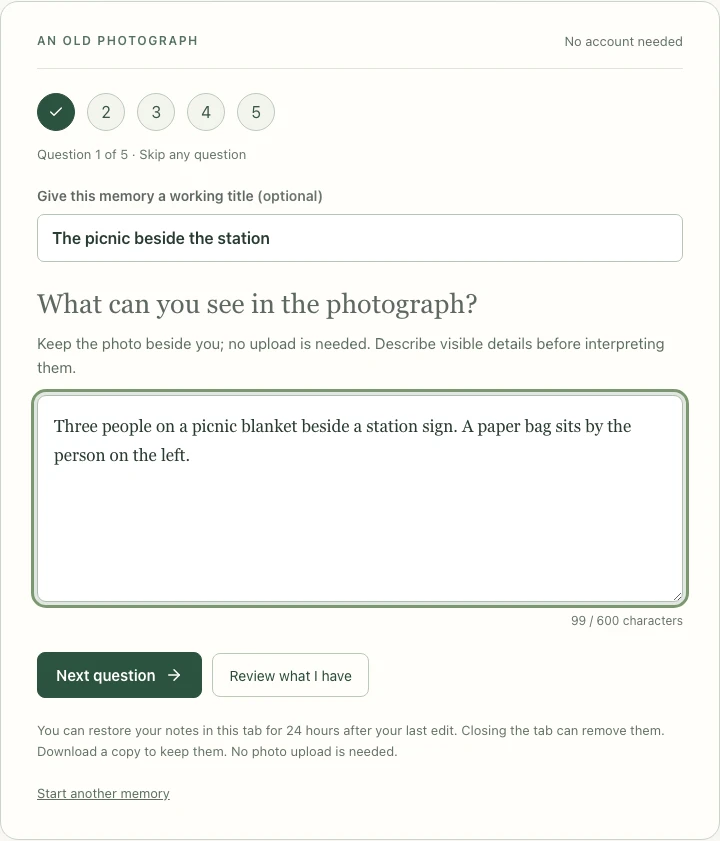
Actual MemoirWell worksheet in a local product preview, with synthetic text. The photograph stays beside the writer; this form does not upload it.Current product path: https://app.memoirwell.com/tools/memory-starter?topic=photo 2. Keep the answers and their question marks
Review the exact words you wrote. Copy them or download a text file without an account. Continue with these notes opens sign-in in the same tab; afterward, you can explicitly add the notes to an empty studio answer without replacing existing text.
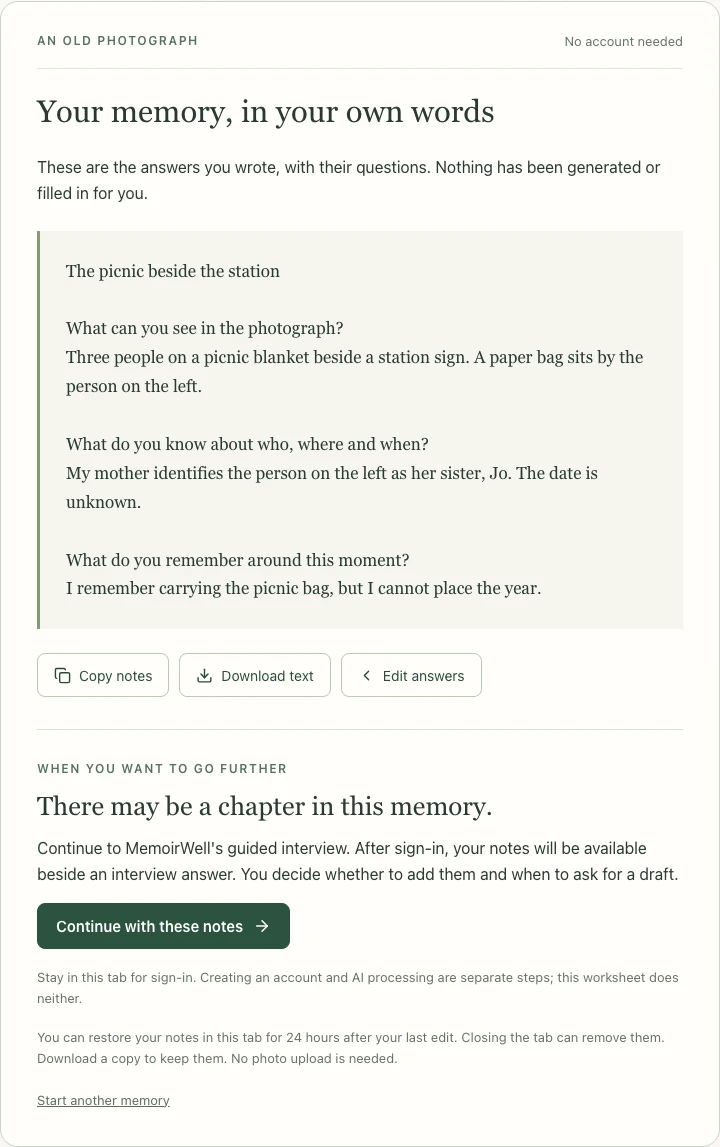
Actual MemoirWell review screen in a local product preview, using synthetic notes. The wording and unknown date remain exactly as entered; no AI draft has been requested.Current product path: https://app.memoirwell.com/tools/memory-starter?topic=photo
FAQ
What are the best questions to ask about an old family photo?
Ask who is pictured, how the people knew one another, where and roughly when it was taken, what happened before and after, what detail a stranger would miss, why the photograph was kept, and what remains uncertain.
How many photographs should I use in one family interview?
Three to five related photographs are often manageable for a first session, but the number is not a quota. Use fewer when one image opens a long story or the narrator wants to stop.
What if nobody knows the exact person or date?
Preserve the uncertainty. Record the inherited caption, each relative's account, the clues supporting a date range, and the next source to check instead of turning a resemblance or guess into fact.
Should I scan the photographs before the interview?
A safe reference image makes the photograph easier to share and discuss while reducing handling of the original. Preserve the front, back, album context, and original order, and do not force a fragile photograph from an album.
How do I match a recording to the correct photograph?
Give each photograph a stable ID, say it aloud when discussion begins, include it in filenames and transcript headers, and create a time-coded index linking the photo, recording, notes, and restrictions.
Sources and review date
Sources were last reviewed on .
- Library of Congress Preserving Family Stories
- Library of Congress photographic evidence guide
- Library of Congress personal audio archiving guidance
- Oral History Association 2025 principles and best practices
- National Archives family digitization guidance
- National Archives family-photo research case study
- U.S. Copyright Office guidance for photographers