How to interview your grandparents about their life
The best grandparent interviews do not try to collect an entire life in one sitting. They help your grandparent enter one ordinary scene, follow what matters to them, and decide what may be recorded or shared. This plan gives a 45-minute shape to the conversation, but a comfortable 15 or 20 minutes is already enough.
By Danila Pryadko · Updated
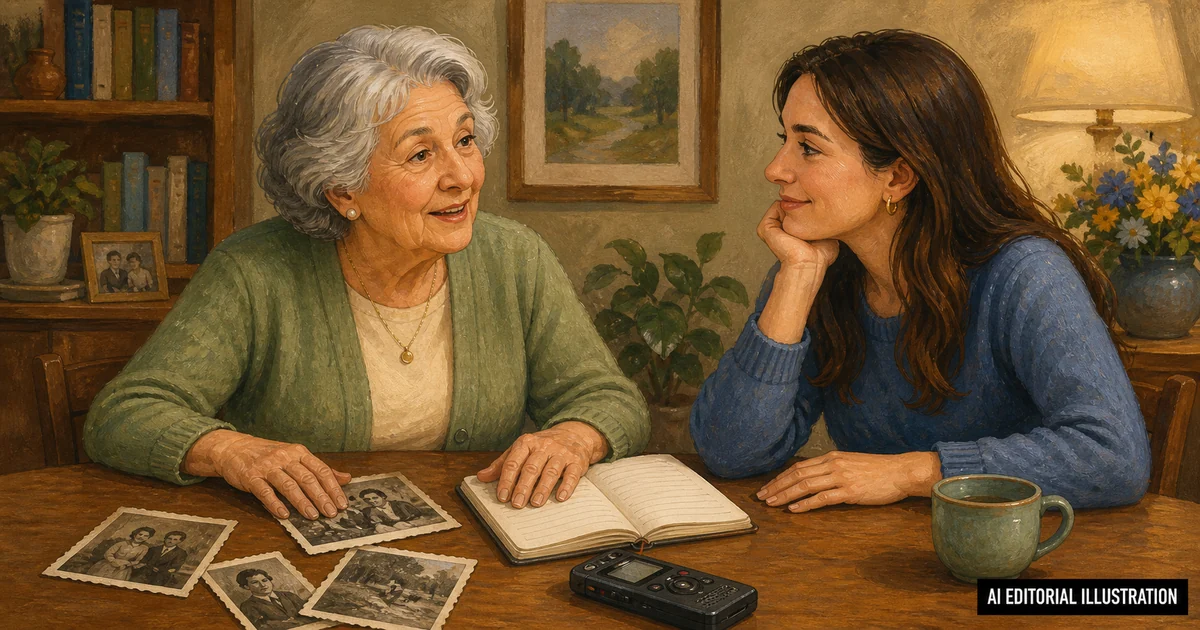
Publisher disclosure: MemoirWell develops family-story interview and memoir-drafting software, so this is first-party educational content rather than independent product coverage. The interviewing and consent practices below draw on guidance from the Smithsonian Institution Archives and the Oral History Association, reviewed on August 27, 2026. The example questions are original editorial examples; they do not come from a customer interview or private family record. MemoirWell's editorial methodology explains the site's sourcing and disclosure standard.
The 45-minute plan at a glance
| Time | What to do | Goal |
|---|---|---|
| 0-5 minutes | Agree on the purpose, recording, audience, processing, storage, and stop signal. | Your grandparent knows what will happen to the conversation. |
| 5-10 minutes | Warm up with one easy choice between two concrete topics. | Find a memory that feels comfortable today. |
| 10-25 minutes | Stay with one scene and ask short follow-ups. | Capture place, people, sequence, and sensory detail in the narrator's own words. |
| 25-35 minutes | Ask what changed, why the moment mattered, and what remains uncertain. | Give the scene meaning without forcing a lesson. |
| 35-40 minutes | Check names, privacy boundaries, and anything that needs a later source check. | Separate recollection from facts that still need verification. |
| 40-45 minutes | Explain the next step and ask what may be kept, transcribed, or shared. | End with control still in the narrator's hands. |
This is a menu, not a quota. If the story reaches a natural ending after 18 minutes, stop there. If your grandparent wants to continue, schedule another conversation instead of trying to finish a lifetime at once.
Before the conversation: make five choices together
Family closeness is not automatic permission to record, transcribe, publish, or share. Settle these five choices in plain language:
- Purpose: Are you making a private family recording, notes for a chapter, a gift, or material that might eventually be public?
- Method: Will you record audio, record video, take notes, or simply talk today?
- Audience: Who may hear the recording, read a transcript, or see an edited story?
- Control: How can your grandparent pause, skip a topic, correct the result, restrict a passage, or ask for deletion?
- Processing and storage: Will a person or software service upload, store, transcribe, summarize, or edit the material? Where will each copy be kept, who can access it, and how will deletion requests be handled?
A simple opening can be enough:
I would love to keep one story in your own words. We can talk for about 20 minutes, and we can stop or skip anything. Is it all right if I record the conversation for a private transcript that only you and I review first?
If the answer is no, ask whether your grandparent would still enjoy talking without notes or recording. If not, leave the project for another day. A conversation still has value even when it never becomes an archive.
Minutes 5-10: offer an easy starting choice
“Tell me about your life” is too large. Offer two concrete doors and let your grandparent choose:
- Would you rather start with the home where you grew up or your first job?
- Should we talk about an ordinary school day or what weekends felt like?
- Would you rather describe a family meal or a trip you still remember?
A photograph or familiar object can help, but it should support the narrator rather than become a test. Ask, “What does this bring back?” instead of “Surely you remember who this is.” Do not assume the caption, date, or family story attached to an item is correct. For a session organized around specific images, use the photo-led interview questions and source-note workflow.
Minutes 10-25: questions that open one scene
Choose only one group. The useful answer is the one your grandparent wants to follow, not the one that completes the list.
Home and neighborhood
- When you picture the front door of the home where you grew up, what do you see around it?
- What sounds told you that morning had begun?
- Where did people naturally gather, and what usually happened there?
- Who in the neighborhood seemed to know everyone?
School, work, and practical skills
- Walk me through the first hour of a typical school or work day.
- Who taught you a skill that later became useful?
- What rule made sense at the time but would surprise someone now?
- Tell me about a problem you solved without having the right tool or enough money.
Family rituals, food, and celebrations
- Which ordinary meal best represents your family?
- Who did what before guests arrived?
- What family tradition changed as people moved, married, or grew older?
- Was there a recipe, object, song, or saying whose meaning outsiders would miss?
Travel, moves, and change
- What did you carry when you moved away from a familiar place?
- When did you first realize that everyday life was changing?
- Which new invention or custom took the longest to feel normal?
- Tell me about arriving somewhere and knowing things would be different.
Follow-ups that turn a summary into a story
After a promising answer, stop searching for a better question. Use one short follow-up at a time:
- Where exactly were you?
- Who else was there?
- What happened immediately before that?
- What did you notice first?
- What happened next?
- How did you know something had changed?
- Which part are you least certain about?
- Is there anything in this story you want kept private?
Silence is also a follow-up. Give the narrator time to continue. Do not fill every pause or correct a date while the scene is still unfolding.
Minutes 25-35: ask about meaning without demanding a moral
A memoir needs perspective, but every story does not need a neat lesson. Try:
- What did you understand then, and what do you understand differently now?
- Did that day change what you did next, or did its importance become clear later?
- What would someone younger misunderstand about that time?
- Which part of this story feels most like you?
Avoid putting an answer in the question. “You must have been terrified, right?” asks the narrator to agree with your interpretation. “What did you feel at the time?” leaves the answer open.
Minutes 35-40: handle names, uncertainty, and privacy
Wait until the story is complete before checking details. Read back only the points that matter:
- the spelling and preferred form of a person's name;
- the place and approximate period;
- the order of two events when the chapter depends on it;
- which detail came from memory, a photograph, a document, or another relative;
- which passages may remain in the recording but not in an edited story.
Do not turn uncertainty into a failure. Record “around 1968,” “I think it was spring,” or “my sister remembers this differently” when that is the honest state of the evidence. Check important claims later against photographs, letters, calendars, public records, or another account without silently replacing the narrator's recollection.
Minutes 40-45: explain exactly what happens next
Do not leave with a recording and a vague promise to “make something from it.” Say what you will do and what you will not do:
- Copy and label the original recording without editing it.
- Make a second backup before creating a transcript.
- Mark unclear words and uncertain facts instead of guessing.
- Shape one candidate story while keeping the source available.
- Return the transcript or draft in a comfortable format.
- Share only the exact version and audience your grandparent approves.
A short closing question protects that boundary: “May I keep this recording, make a private transcript, and bring the draft back to you before anyone else reads it?” Permission for those steps does not automatically include a website, social post, public archive, podcast, or commercial book.
If you are interviewing from another city
A remote interview can follow the same plan. Test the call platform with a one-minute sample, use the device your grandparent already finds comfortable, and decide who is responsible for starting and saving the recording. Keep a telephone alternative if video becomes distracting. Send at most one or two prompt photographs in advance and identify them by something visible, not by a file name your grandparent cannot see.
Do not record a call secretly or assume the platform's recording notice settles family consent. Discuss the purpose, audience, and review process in your own words, and follow the law that applies where everyone is located.
What not to ask
- Do not use “before it is too late” to pressure participation.
- Do not ask several questions at once.
- Do not demand exact dates in the middle of a scene.
- Do not assume a difficult event should be discussed because it seems historically important.
- Do not promise that software will automatically create a finished, accurate book.
- Do not publish an edited version before the narrator can review it.
A one-page question card
If you want a compact card beside you, use these seven prompts:
- Which place should we begin with today?
- Who was there?
- What usually happened, and what was different that day?
- What detail do you still see, hear, or feel clearly?
- What happened next?
- What are you uncertain about or remembering differently now?
- What may I keep, write down, or share from this story?
FAQ
What is the best first question to ask a grandparent?
Offer a choice between two concrete, comfortable topics, such as the home where they grew up or their first job. Then ask for one ordinary scene rather than a summary of their whole life.
How many questions can I ask in 45 minutes?
Plan several, but expect one or two strong questions to fill the session. Follow a meaningful answer instead of trying to complete a list.
What if my grandparent does not want to be recorded?
Ask whether they would still enjoy talking without recording or notes. Continue only if they agree, or stop the project without pressure.
What if a date or detail is uncertain?
Record the uncertainty, ask about surrounding people, places, seasons, or events, and check important claims later. Do not pressure the narrator or turn a likely detail into a confirmed fact.
Should I correct a story during the interview?
Usually not. Let the narrator finish, then compare recollection with records or other accounts later while preserving disagreement when certainty is unavailable.
What should happen after the interview?
Label and back up the original recording, create a careful transcript, mark uncertainty and privacy limits, and let your grandparent review the exact edited version before sharing.
Sources and review date
This guide and its sources were reviewed on .